The Craft of Bringing Things Back to Life: Steve’s Auto Trim
At a Glance
Who: Steve Parrish
What: Automotive and custom upholstery and trim
Where: Pilot Mountain, NC
Since: 1996
What Makes it Special: For nearly 30 years, Steve’s Auto Trim has been restoring, repairing and reupholstering everything from vehicle interiors to commercial seating and furniture. But the story is about more than upholstery. It's about craftsmanship, hard work, helping people, and passing a skill from one generation to the next.
Visit / Connect
Business name: Steve's Auto Trim
Address: 145 West Main Street, Pilot Mountain, NC 27041
Phone: 336-368-1049
Email: stevesautotrim@yahoo.com
Social media: Facebook
Hours: Monday–Friday, 8:00 a.m.–5:00 p.m.
Best way to connect: Stop in for an estimate or call to schedule an appointment.
The Story
Some of the businesses that make a community special aren't necessarily the ones you notice first.
They're the ones where someone has spent decades learning how to do something well—really well—and continues showing up every day to do it.
Steve's Auto Trim is one of those places.
Walk through the door and you may see a damaged seat being carefully rebuilt, a piece of foam being cut to replace a worn section, or a sewing machine being used to do work that looks deceptively simple until you realize how much precision goes into every stitch.
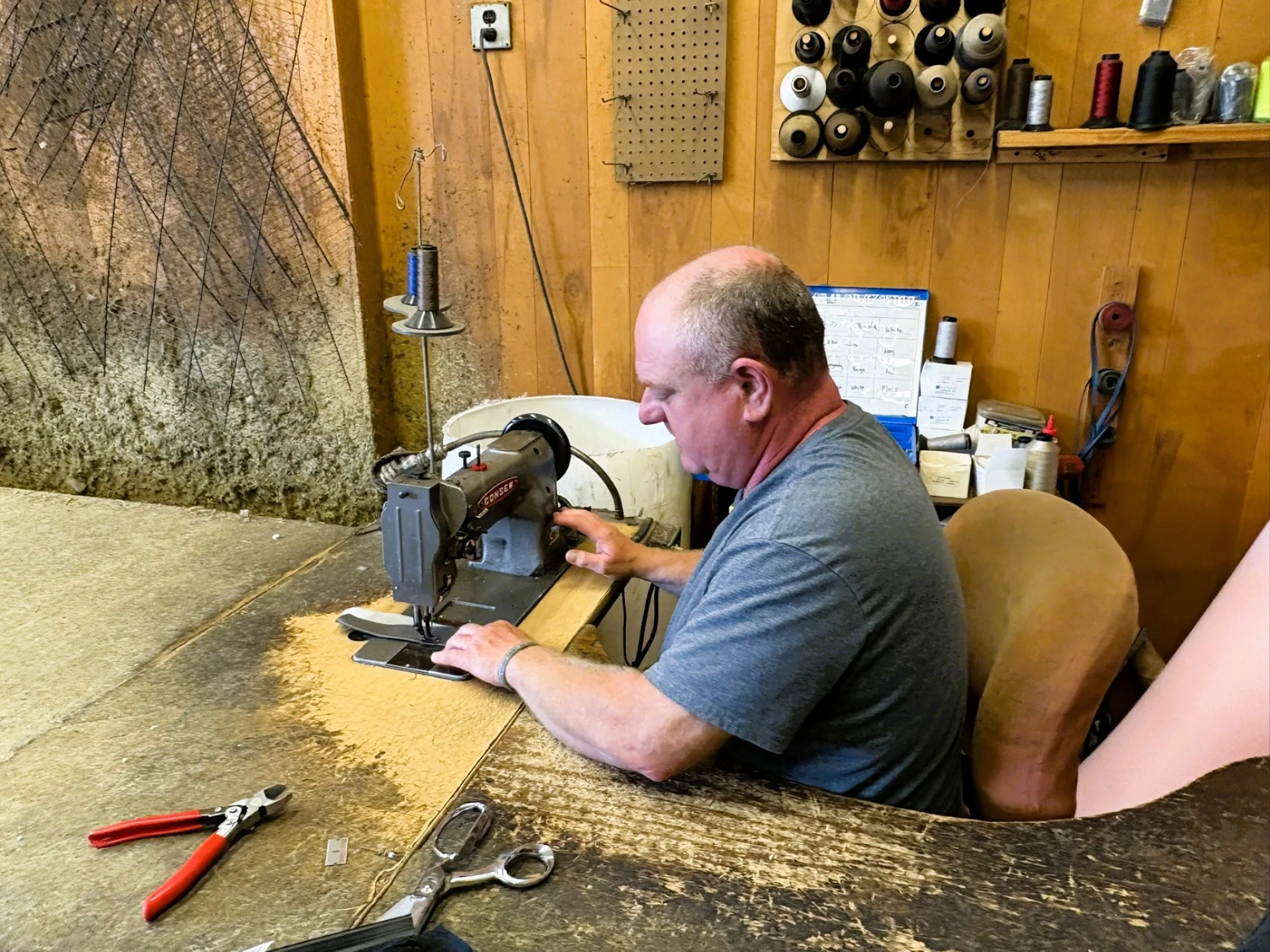
Steve demonstrates the precision involved in upholstery work at his Pilot Mountain shop.
For Steve, this isn't simply upholstery.
It's a craft he has been learning and practicing for most of his life.
And the story of how he got here begins when he was just 12 years old.
Meet Steve
Steve started working with his uncle Clyde when he was 12.
Clyde did upholstery work in Rural Hall, and Steve began learning the trade alongside him. In those early years, Steve handled many of the jobs that prepared a piece for the more precise upholstery work—taking seats apart, pulling staples, removing old covers and getting everything ready for the next step. He was learning by watching, doing and working alongside his uncle. There was plenty to learn—and plenty of opportunity to learn from mistakes.
But becoming an upholsterer didn't happen overnight.
Steve says he was about 18 before his uncle began letting him move beyond some of those early tasks.
Clyde had a simple philosophy: Steve shouldn't do something if Clyde couldn't fix it if it went wrong.
It was a lesson in craftsmanship, but it was also a lesson in responsibility.
That early training stayed with Steve.
From Learning the Trade to Building a Business
He had been in the upholstery business for about ten years when, in 1996, he purchased the business on Main Street in Pilot Mountain from Burton Montgomery.
At the time, the shop sat next door to the floral shop owned by Steve's wife, Amy. Burton had done both furniture and automotive upholstery, and he also sold cars there.
Steve took over the business and has been at the same location ever since—now 145 West Main Street.
Nearly 30 years later, that same location remains home to Steve's Auto Trim.
There's something fitting about that kind of continuity.
In a community where buildings and businesses each have their own stories, Steve's Auto Trim has become part of Pilot Mountain's story, too.
The Details Are the Difference
Ask Steve what separates a good upholstery job from a great one, and his answer comes down to something that sounds simple but isn't:
The details.
Straight stitches. Symmetry. Making sure everything lines up.
Making sure the lines in the seat cover properly align with the welt cord
Those are the things a customer may not consciously notice when the job is done—but they are the things that make the finished piece look right, polisheded and special.
And I got a chance to see some of that attention to detail up close.
Steve recently reupholstered the interior of my husband's 1993 red-and-white Ford F-150. When I visited his shop, he took the time to show me the work, explain what he was doing, and walk me through some of the tools and fabrics he uses.
The truck interior looks like new.
But seeing the work in progress helped me understand why.
Reupholstering a vehicle seat is much more than putting a new cover over an old one.
The process begins by removing the seat from the vehicle and stripping away the old upholstery. Once the seat is bare, the frame and springs can be inspected, cleaned and repaired as needed.
Worn burlap or other support material and damaged foam may need to be replaced so the seat has the proper shape and support again.
Then comes the part most of us probably think of as “the upholstery”—but even that takes careful work.
The new material has to be fitted and pulled into place. The cover is secured to the frame with hog rings, just as it was originally, and everything has to be centered, tightened and adjusted so the finished seat is smooth and free of wrinkles.
Then the seat is reassembled, put back into the vehicle, and ready for another life.
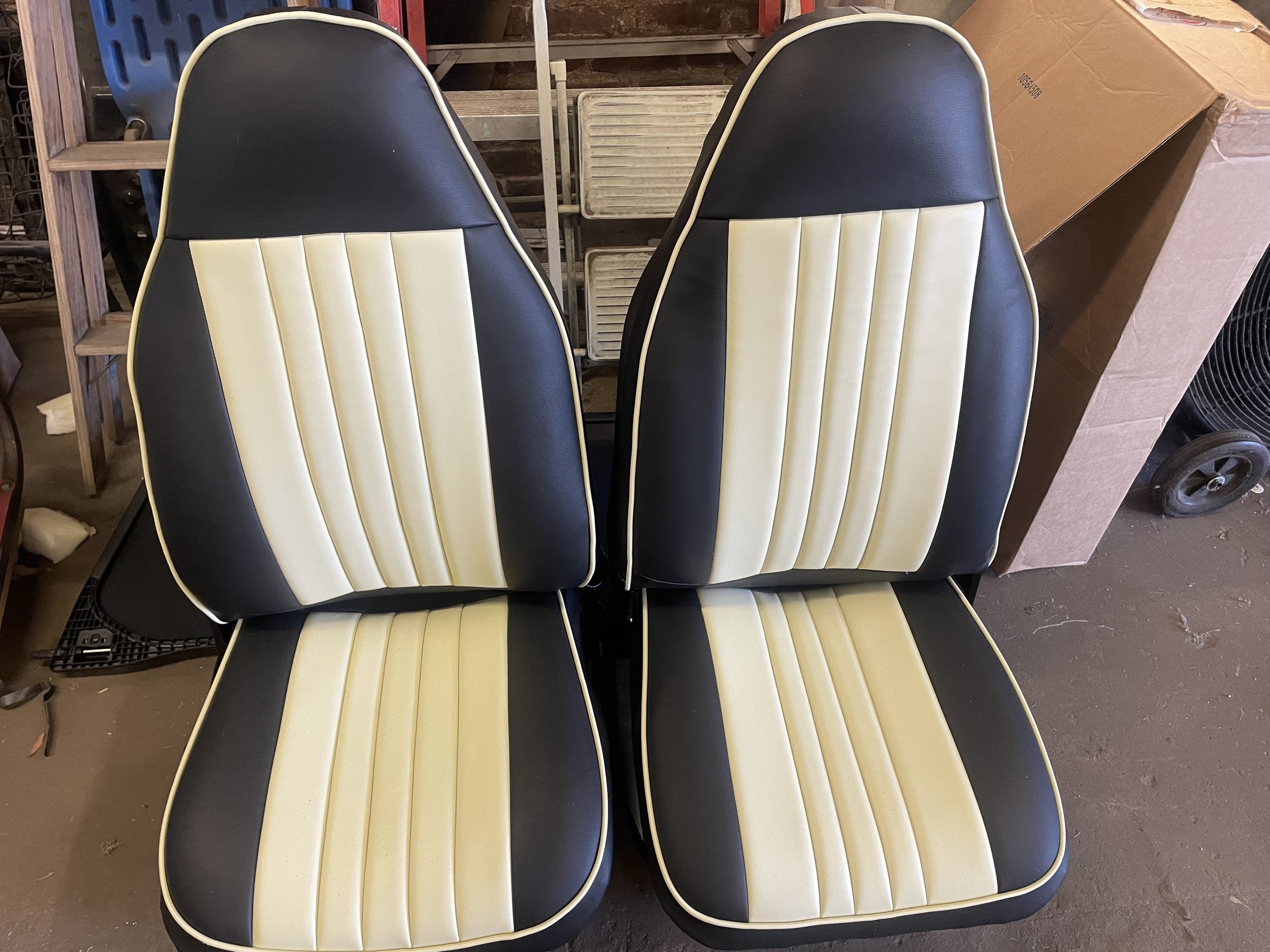
A finished upholstery project, restored and ready for another life.
Seeing Steve demonstrate his work made something very clear to me:
The finished product may look simple. The work that makes it look that way is anything but.
Lot More Than Car Seats
Automotive upholstery may be in the name, but Steve's work has taken him well beyond cars.
Over the years, he has worked on furniture, commercial equipment and restaurant seating, along with plenty of unusual requests.
One of the strangest?
A toilet seat.
Another involved a horse breeder who asked Steve to create a collection container for use in the horse-breeding side of the business.
He made it.
Then there was the rocking chair.
A gentleman brought the chair to Steve wanting it completely restored—not just the upholstery, but the wood and the other elements as well.
The customer agreed to let Steve keep track of his time rather than trying to estimate the work in advance.
When the gentleman came back to pick up the finished chair, he began telling Steve more about why the chair mattered.
He was having it restored as a surprise for his wife.
And then Steve learned something he hadn't known when he started the job:
The gentleman's wife had been Steve's first girlfriend—in the first grade.
Sometimes the story behind the piece is every bit as important as the piece itself.
When There Isn't a Pattern
One of the things that makes this kind of work so interesting is that Steve can't always simply pull out a pattern and get started.
Sometimes he has to make one.
He may take a damaged seat covering apart, study it, and use it to create a new pattern for the replacement material.
He may cut away a large, damaged section of foam and shape a new piece to fit it.
He may replace the burlap beneath the seat, clean and restore the frame, and then begin rebuilding from there.
Steve uses an electric fish knife to cut foam, and his sewing machine is another important part of the process.
And sometimes, there simply isn't a template.
He once worked on a 1927 Star Durant for a 99-year-old gentleman who had been brought in by his nephew. The vehicle had a vinyl roof and cloth interior, but there was no existing pattern for Steve to follow.
So he made one.
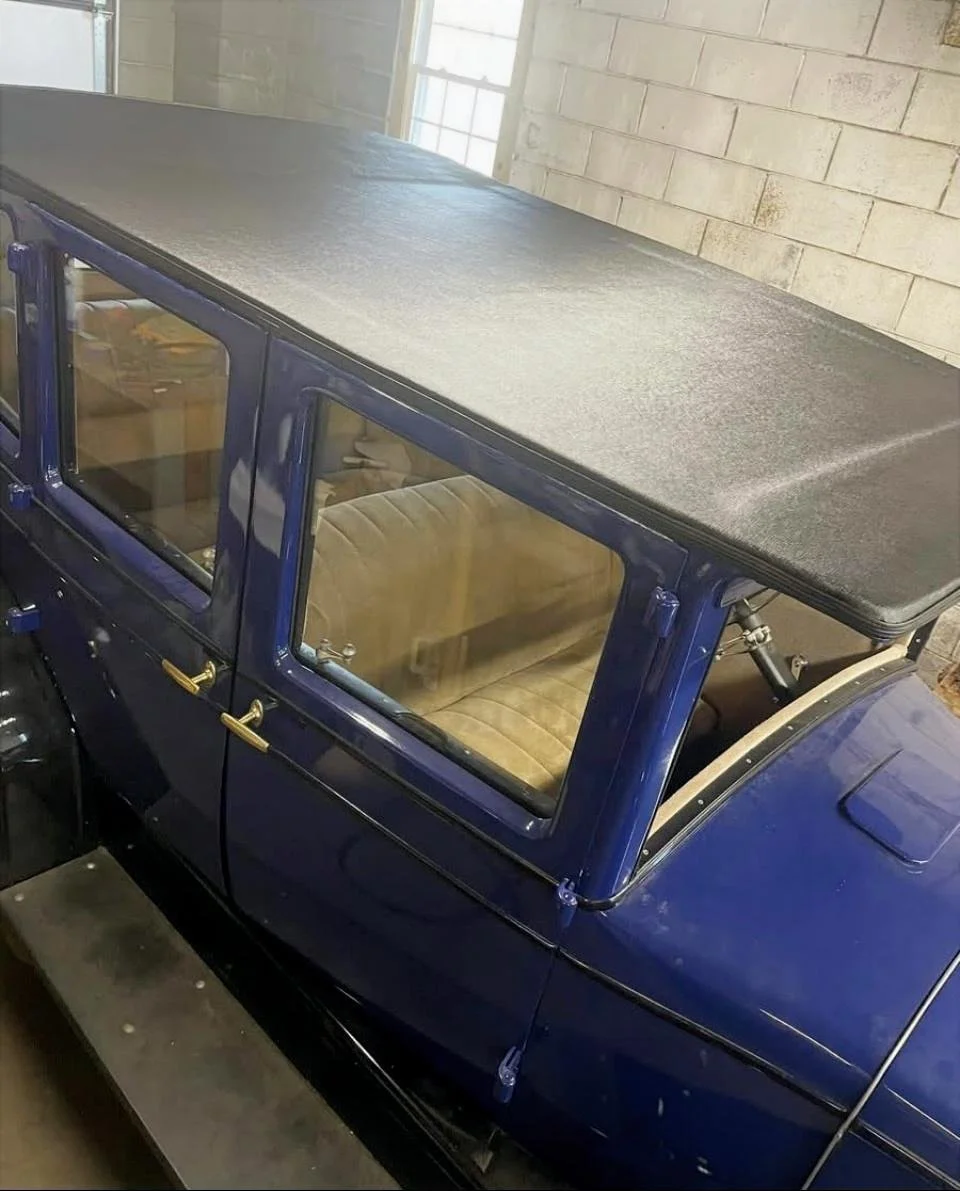
A 1927 Star Durant—one of the vehicles Steve had to create a pattern for from scratch.
That's part of what experience means in a trade like this.
When there isn't a template, you know how to create one.
The Work People Don't See
There is another side of upholstery work that customers may not think about.
It's physical. Very physical.
Years of pulling, stretching, cutting, sewing and working with heavy or awkward pieces take a toll on your hands, shoulders and back.
Steve has learned some tricks along the way.
When working with convertable tops, for example, he knows that letting the material warm in the sun can make it more pliable and easier to work with.
It's the kind of knowledge that doesn't necessarily come from a manual.
It comes from years of doing the work. And Steve takes great pride in what he does.
That pride is evident when he talks about the finished product—and when he takes the time to show someone how the work is done.
Quality Matters. So Does Time.
Steve's customers aren't all local.
Some of the large corporations he works with are located across the state, and their needs can be very different from those of someone bringing in a family vehicle or treasured piece of furniture.
His work isn't always the least expensive option.
But quality matters.
And so does turnaround time.
For a commercial customer, when a seat is out of service, the vehicle may be out of service, too—and time is money.
Steve understands that.
His goal is to do the work well and get that vehicle back where it belongs—as quickly as he can.
That combination of craftsmanship and turnaround has helped him build relationships that extend well beyond Pilot Mountain.
Learning the Craft
Steve also introduced me to his assistant, Mike, who has been working with him for about 10 years.
There is something fitting about that relationship.
Mike is learning alongside Steve in much the same way Steve once learned alongside his uncle Clyde.
The tools may have changed, and the details of the work may be different, but the basic idea remains the same: learn the craft, pay attention, do the work right, and keep getting better.
There is something special about seeing a skill like this continue to be passed along—not through a textbook or a video, but from one set of experienced hands to another.
Passing Along the Craft
And now Steve is beginning to pass that knowledge along in another way.
Steve is teaching an Automotive Upholstery class at Surry Community College. The night class is hands-on and focuses on restoring automotive interiors.
Students learn how to tear down and rebuild upholstered seats, repair or replace seat components, select and install new upholstery materials, and use sewing machines, cutting tools and other upholstery equipment.
In other words, Steve isn't simply telling students about upholstery.
He's teaching them how to do it.
For someone who began learning the trade at 12 years old, there's something especially meaningful about sitting down with students and teaching them the same kind of hands-on skills that shaped his own life.
The work is hard. It takes patience. It takes precision.
And, as Steve learned from his uncle Clyde, it takes a willingness to learn how to do something correctly before you're trusted to do it on your own.
Now he gets to pass some of that along.
The People Who Become Part of the Story
Mike isn't the only person whose work became part of Steve's story.
Steve told me about Delmer Ray Cook, who spent 18 years working alongside him.
Delmer had retired from Surry-Yadkin Electric before coming to work with Steve, eventually becoming his right-hand man.
And then Steve said something that really stayed with me:
“If I am honest, he taught me more than I ever taught him.”
Delmer's lessons weren't about upholstery.
They were about living life to the fullest and loving your family deeply.
Delmer passed away last November—on Steve's birthday.
Over those 18 years, they shared the work and, as Steve put it, some really good times together.
There's something fitting about that story being part of Steve's.
Because when you spend that many years working alongside someone, they become more than an employee or coworker.
They become part of your life.
Sometimes Helping Is Just Part of the Job
There is another part of Steve's story that I think says a lot about who he is.
Steve shared several stories of times when he has made, repaired or figured out something for someone simply because it was the right thing to do.
I have firsthand knowledge of one of those.
My husband had purchased a piece of sheepskin to put on the arms of the recliner where his mother spends a lot of time sitting, hoping it would provide some relief for her sore elbows. We weren't sure how we would keep the sheepskin from slipping off, so my husband took it to Steve and showed him what we were trying to do.
Steve told him to leave it.
Before my husband had even made it home, Steve was calling to say it was ready.
He had simplydone it because he wanted to help.
When I reminded Steve of what he had done with the sheepskin, he began sharing other stories of times he had gone out of his way to make someone more comfortable or simply make something easier for them.
The more he shared, the more I realized the sheepskin story was part of a larger pattern.
He doesn't make a big production of it. He sees something he can do, and he does it.
And sometimes, I think, those little things tell us more about a person than anything else.
Steve's Auto Trim & Pilot Mountain
Steve's connection to Pilot Mountain didn't begin with the upholstery shop.
It came through his wife, Amy, who was raised in the Shoals community.
When they married, they knew they wanted to make Pilot Mountain their home.
Steve says, in a way, Amy brought him to Pilot Mountain.
This December, they will celebrate 30 years of marriage.
Steve's connection to the community extends beyond the shop, too.
He supports local youth and community organizations and has allowed groups to use his parking lot during downtown events, such as car shows, to set up and raise money—with an important condition.
He wants the kids to actually be involved in the work.
That matters to him because he understands the value of learning a strong work ethic firsthand.
It's the same lesson his uncle Clyde taught him all those years ago.
Work matters. Learning matters. And doing something well matters.
Steve also speaks with genuine pride about his son, Nate, who has worked alongside him at the shop and returns during summer breaks.
Nate is currently a student at NC State University, where he is a Ben Franklin Scholar double-majoring in Aerospace Engineering and History.
His interest in aerospace began when he was very young, following a family trip to the Kennedy Space Center in Florida.
His dream job?
Working for NASA.
Steve is clearly very proud of him.
What Stood Out to Me
What stayed with me after spending time with Steve was how much of this work happens in the details.
It's easy to look at an old seat and see something worn out.
Steve sees what it can become.
A damaged section of foam can be cut away and replaced.
A worn cover can become a pattern.
A frame can be cleaned and restored.
New material can be cut, sewn, stretched and fitted until everything lines up exactly as it should.
And somewhere in that process, something that might have been discarded gets another life.
But I think there was something else I noticed, too.
Steve seems to approach people much the same way he approaches his work.
He looks at what needs to be done, figures out how to do it, and gets to work.
Sometimes that means creating a pattern where there isn't one.
Sometimes it means repairing something most people would have given up on.
Sometimes it means teaching someone else what he knows.
And sometimes it simply means saying, Leave it with me, because he knows he can help.
That's a pretty good metaphor for the kind of craftsmanship—and neighborliness—that still exists in small communities.
You don't have to make something flashy to make something valuable.
Sometimes you simply have to know your craft, care about the people you're helping, and care enough to do it right.
If You Go
If you're visiting Steve's Auto Trim for the first time—or if you're a return customer—you can simply stop in during regular business hours for an estimate, or call during regular business hours to schedule an appointment.
Steve has a small amount of parking available right in front of his building. Otherwise, convenient street parking is available along Main Street, or you can park in the Pilot Mountain Town Hall parking lot, less than a block away.